HOW IT WORKS ?
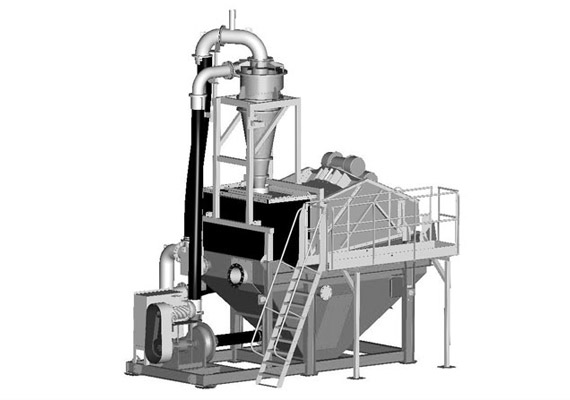
Slurry enters the feed inlet at a designated pressure and volume. Independent of the shape or configuration of the inlet, slurry follows the fall of the upper cylinder in a rotating action. Resultant centrifugal forces send coarser material to the outer wall to travel downward and be further accelerated in the conical sections. These coarser fractions then exit through the apex, or spigot, at the bottom of the Duromech’s Hydrocyclone. Finer fractions remain rotating with the fluid in the inner core and are removed upward by an air core.
The air core is formed at the spigot/apex as air is drawn in to the Hydrocyclone. The vortex finder provides a pathway for the air to exit the body of the Hydrocyclone. As the air flows through the vortex finder, the fluids and finer fractions are dragged along to perform the classification of materials. The air core is important for the proper operation of the cyclone. If the air core is not formed due to excessive solids discharge, called roping, the cyclone will not efficiently classify the slurry. The apex/spigot is sized for the expect range of solids. Significant process changes may require a resizing in the spigot/apex.
Duromech has collected field data from hundreds of applications, allowing process engineers to make the accurate selection of size and configuration for each application using computer simulations. Performance is influenced by the size of the unit and its operating pressure, as well as the inlet area, vortex finder diameter, underflow and overflow diameters, cylindrical sections and cone angle.
BENEFITS OF DUROMECH’S HYDROCYCLONE :-
1. No moving parts
2. Process high volumes
3. Small footprint
4. Simple to operate
5. Rubber-lined standard; urethane and ceramic lining optional
6. 4” to 36” (100mm to 900mm) sizes are available
7. Multiple cone angles are available
8. Strong process support and systems integration